

2026-05-18
Growing up in South Africa, Emese's connection to Hungary was defined by a name that sounded unusual there, a few Hungarian words, and fragments of family stories. When she began her studies in the country, she was still full of doubts, but she overcame them—and by now, alongside embracing her Hungarian identity, she has also found her professional goals. In our interview with her, we explore the path that led her here, learn how her background in liberal arts influences her architectural studies, and find out which Hungarian building is her favorite.
Voices of Hungarian Diaspora Students is a new interview series that tells stories of hazatalálás — finding one’s way home — through the personal journeys of students with Hungarian roots from around the world. Homecoming can take many forms: discovering a professional path at university, finding friendships and a sense of belonging, shaping a life goal that gives direction, or reconnecting with long carried cultural roots — sometimes all at once.
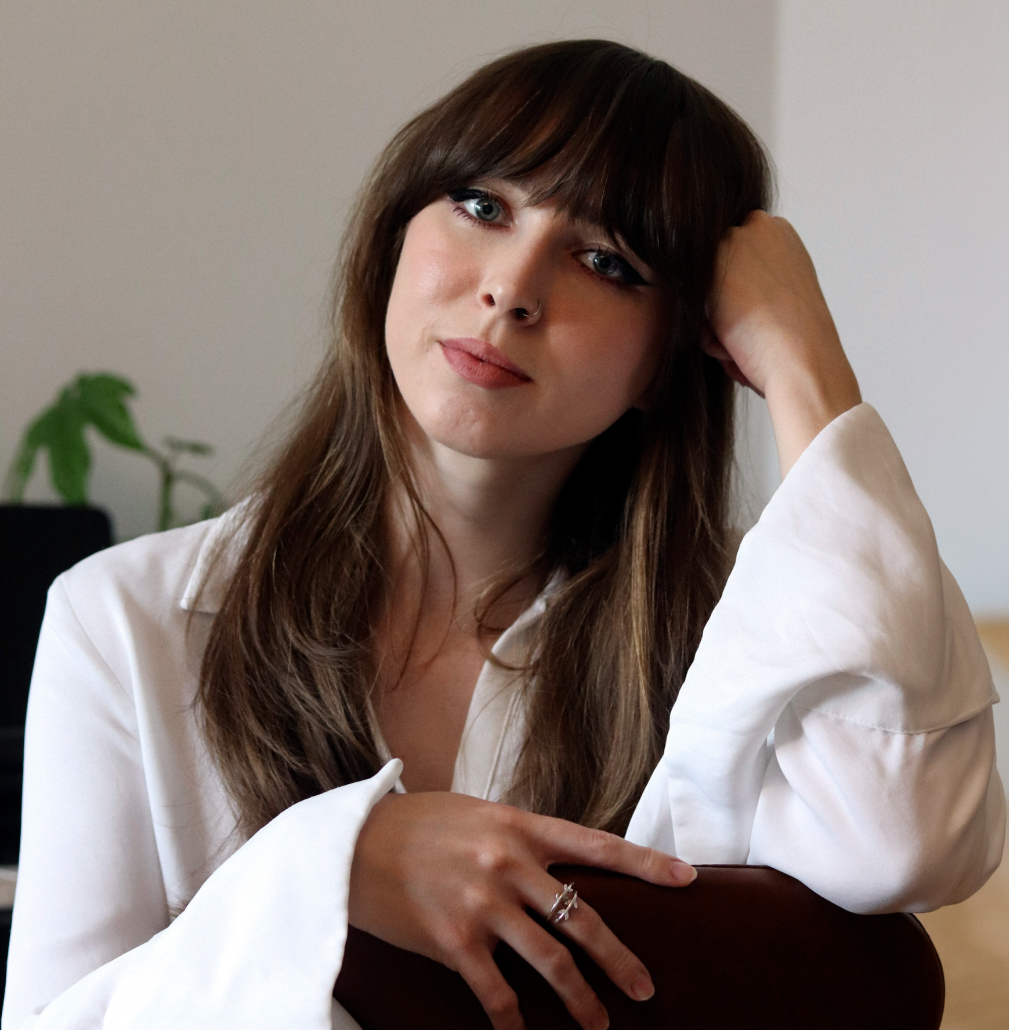
In this first episode, we meet Emese Kiss, who grew up in South Africa surrounded by fragmented stories about her father’s Hungarian family. As a Hungarian Diaspora Scholarship student, she was given the opportunity to reconnect with her Hungarian heritage — and, in the process, to find her own voice, her professional direction, and a deeper sense of where she belongs. Through her story, we glimpse how identity can quietly unfold when courage meets curiosity.
Your grandparents left Hungary in 1956, and you were born into a completely different world in South Africa. What stories reached you from this family history, and when did you start to feel that this past was somehow part of your own identity as well?
Growing up, the story of my grandparents leaving Hungary in 1956 was always there, but more in a distant and abstract way. I had some idea that it was tied to a moment of upheaval and uncertainty, but I would not hear the story all in one go, rather in fragments – short stories, references to what was left behind, or the odd trace of culture that was still in our family. Village anecdotes of my grandmother, the family they left behind, Hungarian traditional clothing, words and songs I caught glimpses of growing up.
As a child in South Africa, Hungary did not feel like part of my immediate reality. It was not something I thought of much or confronted, it was just kind of there in the background, the most confrontation I had with it was trying to explain my name to people. Even when I first moved to Hungary, I did not feel yet that this past was part of my own identity.
I believe the turning point was on one of the trips in the Balassi Programmes. Being together with others in my shoes – coming from somewhere else to where our family is from – and exploring the beauty of Hungary, learning the history, was when it no longer felt like just my grandparent’s story, but something that was a part of me. It was a piece that had felt missing all the years and that I did not pay attention to, that finally came into the spotlight.
Do you remember the moment you first arrived in Hungary?
Before coming to Hungary, I had practically no idea of what to expect. We moved around a lot during my childhood (in South Africa), so I suppose in my own ignorance I thought that it would be something similar to another move, just a great deal further away. Perhaps a part of me wanted it to be the same, in fear of something being too different to comprehend – which in part, it was.
So when I arrived I definitely felt more like an outsider. I remember that everything felt so strange and different to me…it was a bit of a shock, but in time I got used to it. Slowly, and by degrees, I got used to the idea of this being my new home, especially once the language barrier that separated me from this new world started coming down. I truly feel that that was the biggest separator (the language). And something smaller that also took time for me to adjust to was not being able to hear the ocean. Previously, even though we never lived directly close to the beach, I could always hear the sound of waves crashing against the shore, now suddenly that comforting distant roar was gone. Although I did not immediately experience a kind of “coming home” feeling, I had a more “this is a very new and different place that needs some time to feel like home” experience.
Are there objects, smells, foods, childhood memories, or even specific words that strongly represent “Hungarian” identity for you?
Definitely the smell of my father’s gulyás leves, the taste of túrós csusza, the song from Magyar Népmesék and the memory of watching that and ‘Vuk’ with my siblings when we were kids, as well as wearing a ‘hímzett szoknya’ to Sunday school, all strongly represent the Hungarian identity to me. Although I grew up far outside of Hungary and without a Hungarian community, I had these things that first impressed upon me the idea of a Hungarian identity.
In what form was the Hungarian language present during your childhood? Did anyone in your family speak it, or did you encounter it as something completely new?
During my childhood, the Hungarian language was present mainly as a small collection of words my father taught us. He and my Hungarian grandmother both spoke the language, and they would occasionally teach us a few words. I also encountered it when we watched Népmesék or when I heard my father speaking on the phone with one of his Hungarian friends.
So it was not entirely new to me; however, my knowledge remained a small and scattered set of words, which was hardly sufficient ammunition for the complex and intricate army of grammar I would later face when I began learning the language more seriously.
Was there any Hungarian word you already knew and carried with you before the language course?
Among the basics and random words that were taught to us as kids – nem, igen, anya, apa, and so forth, that was about all I carried with me before the language course. Funny enough, according to my parents, one of my first full sentences I spoke as a baby was a mixture of Afrikaans and Hungarian:
I was watching one of my favorite cartoons – Tom and Jerry – when all of a sudden there was a scene where Tom was outside in the cold and wet snow. Little me could not bear to see him like that, and in my sympathetic distress I called out to him on the television, “Toe maar cica nat!” which translates to something like “It’s okay, wet kitty!” Essentially these kind of random words, some animals and foods as well, made up my early Hungarian vocabulary knowledge before the language course.
You first applied to the language preparatory program at the Balassi Institute. What was this program like? Did you find it easier than students without Hungarian roots?
I think that there is a certain time in everyone’s life where their character gets rooted in, and the year in Balassi was one of those. The program was one of the biggest grounding factors for me to feel at home in Hungary. We had the most wonderful teachers who were extremely patient and encouraging with us. Each day we had a couple of hours of language practice, and in the second half of the program, we were also introduced to Hungarian history, geography, and literature. We also did some trips around Hungary, even to Transylvania, so we could explore and learn more.
Not only was the class material important, but the people I met and the friends I made in the Balassi Programme were as well.
It can be a very confusing and isolating feeling to be of this certain nationality but not even understand what it means to be Hungarian, the language, or the history. So meeting others in the program who came from so many different places but were in the same situation as I was, it was a relief that I was not the only one who felt this way, so clueless. We faced the challenge together of discovering what we are a part of and where we truly come from.
Of course, we had an advantage over those who did not have Hungarian roots. It makes it a lot easier if you have some idea what the language should sound like before diving into learning it. And, I think, if your identity is embedded in that language you are learning, it helps with motivation – almost like a “this is a part of me I need to nurture” feeling, as opposed to learning the language without any connection to it at all.
You began your studies in liberal arts, then later transferred to architecture. What do you think is the common thread between liberal arts and architecture? Is there a way of thinking or a perspective that you found in both fields?
There are, in fact, many connections between the liberal arts and architecture. My change in studies may initially seem like a big jump, but I have found several common threads between the two fields throughout my academic experience. For example, in both programs we study art history, as well as the history of architecture. In the liberal arts program, we spent a lot of time examining the Greeks and the Romans, which we continue to do in architecture – although with less emphasis on their philosophy, and more on their built works.
One particular way of thinking that I have found applicable in both fields is from what I have learned in film writing in the liberal arts. I have discovered that I can apply the same approach when starting a film script and when developing a building design. In film, there is typically a character, a goal, and obstacles or antagonists that stand in the way, as well as an overall structural layout to the story. In architectural design, there is likewise a user, a set of needs (the goal), and obstacles (such as budget, site conditions, weather, etc.) that must all, just as in script writing, be addressed and analyzed. I use this approach as a structural guide for satisfying the needs of the user while navigating and resolving the given challenges.
From the outside, architecture seems both creative and very demanding. From the inside, what does an average week look like for you? Which periods are the toughest, and which subjects require the most energy?
An average week for me in architecture has three phases: learning and consulting, short resting, and working. The first phase is my weekly classes, including lectures, practices, and design consultations. The resting phase is either on a Thursday or Friday evening, when I make time to see my friends and wind down to clear my head for the weekend of work ahead. Then the last phase of the week comes, the weekend, which is the time I use to do drawings and planning designs or making models for the next week’s consultations (or submissions).
The toughest periods for me are right before deadlines – such as a critical consultation or a submission, since we have a lot of drawings and model making to do for these. There are two subjects that I have for practically the whole program and require most of my time and energy – design studio and building constructions. Both are practical and require drawing, a lot, but one is more creative and one more technical and detailed, although the practice I get from both supports one another.
What inspires you? Do buildings, films, cities, people, or completely different fields help you move toward new ideas?
I would say what inspires me the most are stories, people’s stories. Seeing the final product, like a building already standing, can be hard for me to imagine what was the thinking process for it to get there. However, when I get to hear the story behind it, the thinking process, the approach – even the story of the person behind the design, is where the key to inspiration lies for me. Kind of, understanding the “why” and the “how” behind the “what” is where I find the clues to starting ideas and thinking. There is something that architect Bjarke Ingels (Ed. note: Bjarke Ingels is a renowned Danish architect, known for his optimistic, playful, and “pragmatic utopian” designs. He gained international fame for innovative projects blending sustainability with hedonism like CopenHill and major designs including Google’s HQ and the Dryline in NYC.) said about architecture being a way of giving form to what we value, that design becomes a way of expressing what we think is important in how we live. I do believe that this is true, and to each person something different is important, and that can be seen in their design, art, writing, everything, which is why hearing someone’s story is so valuable to me in understanding their work as well as getting inspiration for mine.
What is the most recent story you’ve found inspiring?
The most recent story I found inspiring was the Project Hail Mary film. I had had a long week, so I decided to unwind by going to the cinema – something I really enjoy doing since it allows me to disconnect from distractions and just get immersed in a story. While I trusted the film to be enjoyable because of Ryan Gosling’s performance, it was actually the craftsmanship and story itself that captivated me. The effort and creativity of the filmmakers brought the story to life in an incredibly immersive and realistic way, which reminded me that every extra mile you go on a project can have such a huge impact on the viewer, as well as on the people involved in making the project. On the story side, I found that the resilience and problem-solving of the character under extreme circumstances were inspiring, because it reminded me to appreciate everyday moments more, since these ordinary days seem more valuable after this kind of perspective.
What do you love most about architecture? Are you more drawn to conceptual thinking, visual design, or the practical, hands-on side of the profession?
What I love most about architecture is that there can be many ways to solve a problem, meet the user’s needs, design a building, and it can be beautiful in the same time that it meets all of the conditions and constraints. If you can design a building, you are essentially depicting how someone is going to live in and experience that space, which I truly think is powerful especially if it can be done in an efficient, yet aesthetically pleasing way.
The side of the profession I’m drawn to the most at the moment is the conceptual thinking and planning phase. I absolutely love doing research, finding inspiration and ideas, and different solutions to one project. Then, sitting down with the ideas and information I found to draw and design the solution, I can do that for hours and hours. As a kid, I used to paint and make tiny building models with my father – that, and the fact that I have a tendency to get stuck on small details, makes model making enjoyable yet very time-consuming for me, and only really works if I have enough time. This program has taught me a crucial thing.
What is your favourite Hungarian building, and why?
My favourite Hungarian building is the home of Hungarian architect Rosta S. Csaba, “Egy hajós ház.” Although it is referred to as a boat-concept house, the architect shared with us in a lecture the story behind it, calling it the “house of light.” It is my favourite because of this concept that the house is not shaped first, and then lit, but rather it is shaped by light itself. The spaces are carved by daylight direction, and these openings guide and change your perception and experience throughout the day. I really like this idea, and this perceptual design way of thinking.
What would you like to do after university?
After university, I would like to somehow incorporate my architecture skills and knowledge into my love for film and stories. Ideally, I would draw and design building sets for films or be some kind of consultant for architectural concepts in film. I do want experience in the actual field as well, but mainly I want to do something that tells a story.
Many young people are hesitant about studying abroad because they fear loneliness and isolation. What was your experience? What is it like studying in Hungary as an international student, and how difficult was it to find a community?
My experience was one that I think was not only good, but necessary. Studying abroad, it can be lonely and isolating yes, which is why it was so important for me to find friends and a community. The scholarship already helps so much with that by organizing the HÖOK events with other students, where I found community. Besides that, for me it was not difficult at all to find friends. My Hungarian roommate that I discovered completely by chance on Facebook, was very warm and welcoming, and through her I found my group of close friends who now make Pécs feel like home to me.
Studying in Hungary as an international student for me has been a positive experience. The university and scholarship are very helpful with providing me with what I need, where to go and what to do – at least, that is my experience at the University of Pécs. The international students have a big community and organize many events where it’s possible to meet others and make friends. Furthermore, my professors are all very experienced and responsive to each student. The only struggle point can be the language barrier sometimes outside of university, but my Hungarian lessons organized by the scholarship help with that, as well as the fact that most of my friends here are Hungarian.
I am not naturally an outgoing person, in fact it is the complete opposite. I was scared, and sometimes alone, but it helped when I heard that when you feel that way, the moment you feel scared or awkward – that’s where life begins. It’s true, facing that hesitation and fear, is what made me found myself and learn so many things. So for any young person who feels that way, I would give this advice: “Embarrassment is an underexplored emotion. Go out there and make a fool of yourself.”
Were there any “anchors”—people, habits, community spaces, or hobbies—that helped you the most in feeling more at home in Hungary?
Learning Hungarian is possibly the biggest factor that has helped me to feel adjusted. Other than that, attending HÖOK events has not just allowed me to see more of and get to know the country, but has also introduced me to an amazing community of other scholarship students like me. The combination of these, and, of course, my friends here, as well as my Hungarian boyfriend, make Hungary feel like home.
If you look back at the South African girl who first felt that “something Hungarian” was inside her, what would you tell her now? How did discovering your own story change you?
I would tell her that, she is right to follow her heart and nurture what feels missing. I would tell her to pay attention to that which she has not for years.
Discovering and connecting with my Hungarian side and my grandparents’ history has changed me in the sense that I want to continue to learn, interpret and connect with my Hungarian side.
It has motivated me to stay and to study here in Hungary and learn the language fully. Essentially, it changed me from the shy, clueless South African girl into the curious and motivated South African – Hungarian woman that I am today.